-
In 1953 a young Robert Rauschenberg approached an already revered William De Kooning in his corner of Cedar Tavern with a proposal. Young Bob sought a nothingness in art more profound than what he could render in his “all white” paintings. He dabbled in erasure, but removing his own marks wasn’t quite it. No, he needed to negate someone else’s line. So he asked De Kooning for a “drawing he would miss.” The Dutch painter submitted a work on paper that Rauschenberg spent a month diligently returning to its natural state of blank. Naturally, the result is completely unlike any virgin paper. De Kooning’s hand endures as ghostly clouds, neither drawing nor nothing but a secret third thing.
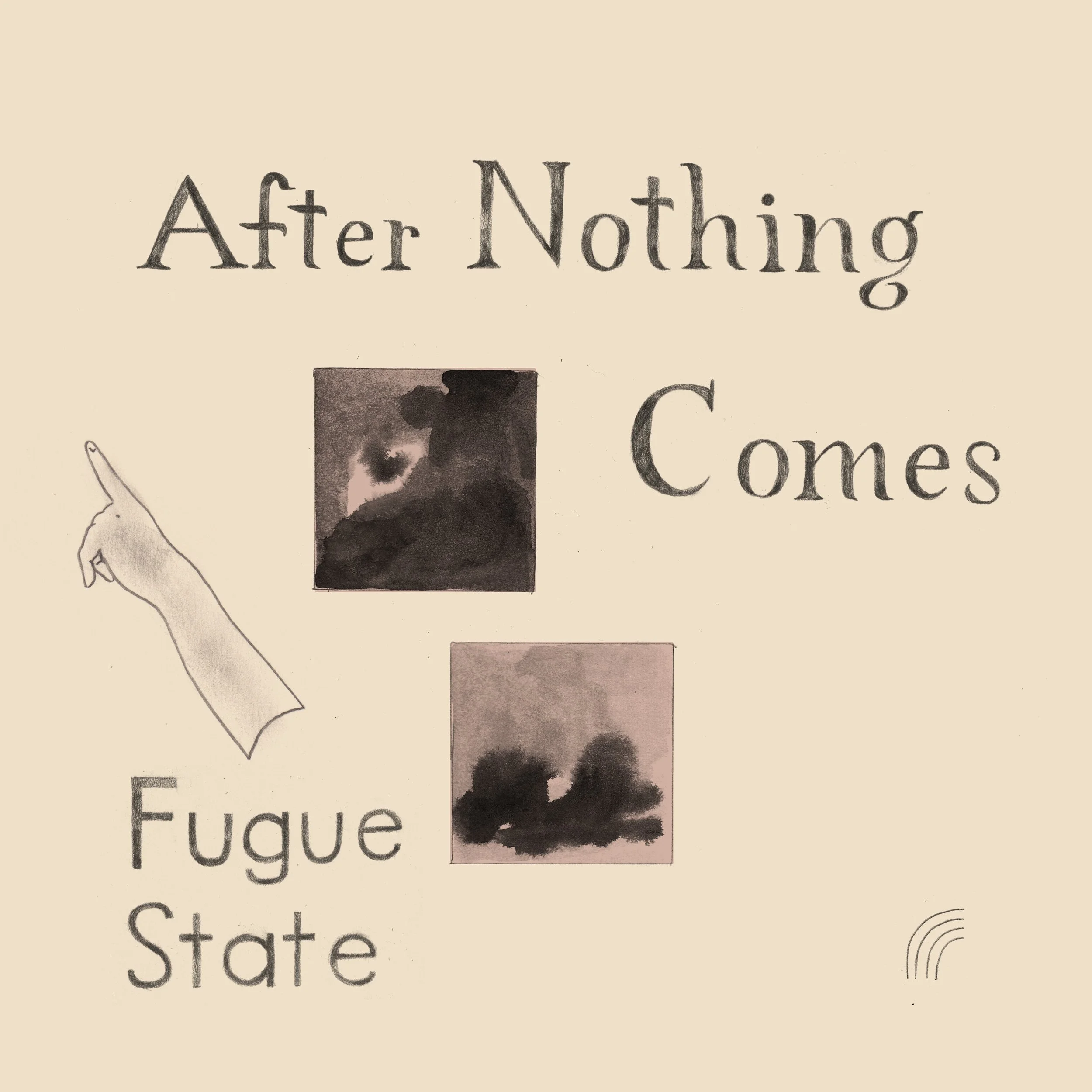
Three quarters of a century later the deconstructive chamber music dub collective Fugue State presents a similarly spectral audible weather system called “After Nothing Comes,” all beautiful melody lines, erased gestures, and uncanny leftovers. Some of the work is recognizable: sax lines, synth parts, human-sung melodies, serpentine basslines. And some of the methods are familiar: scores, lyrics, microphones. But capturing performance is one thing, it is in reworking where Fugue State does the impossible and outlines the ghosts. Voices and woodwind melodies reharmonized, sampled, and distorted through ancient microphone hardware, delicately placed and radically recontextualized. Through an accumulation of unnumbered digital manipulations the sounds arrive somewhere else, neither at the “truth” of its performance nor at the full dissolution of its human hand. The ship of Theseus sailing the .WAVs - how many plugins can you apply to a human performance before it’s no longer human? Are Derrida’s ghosts sitting in a room different from the room you are sitting in now?
“Okay, so you’re saying it’s about the notes that aren’t played, got it, I’m rolling my eyes”
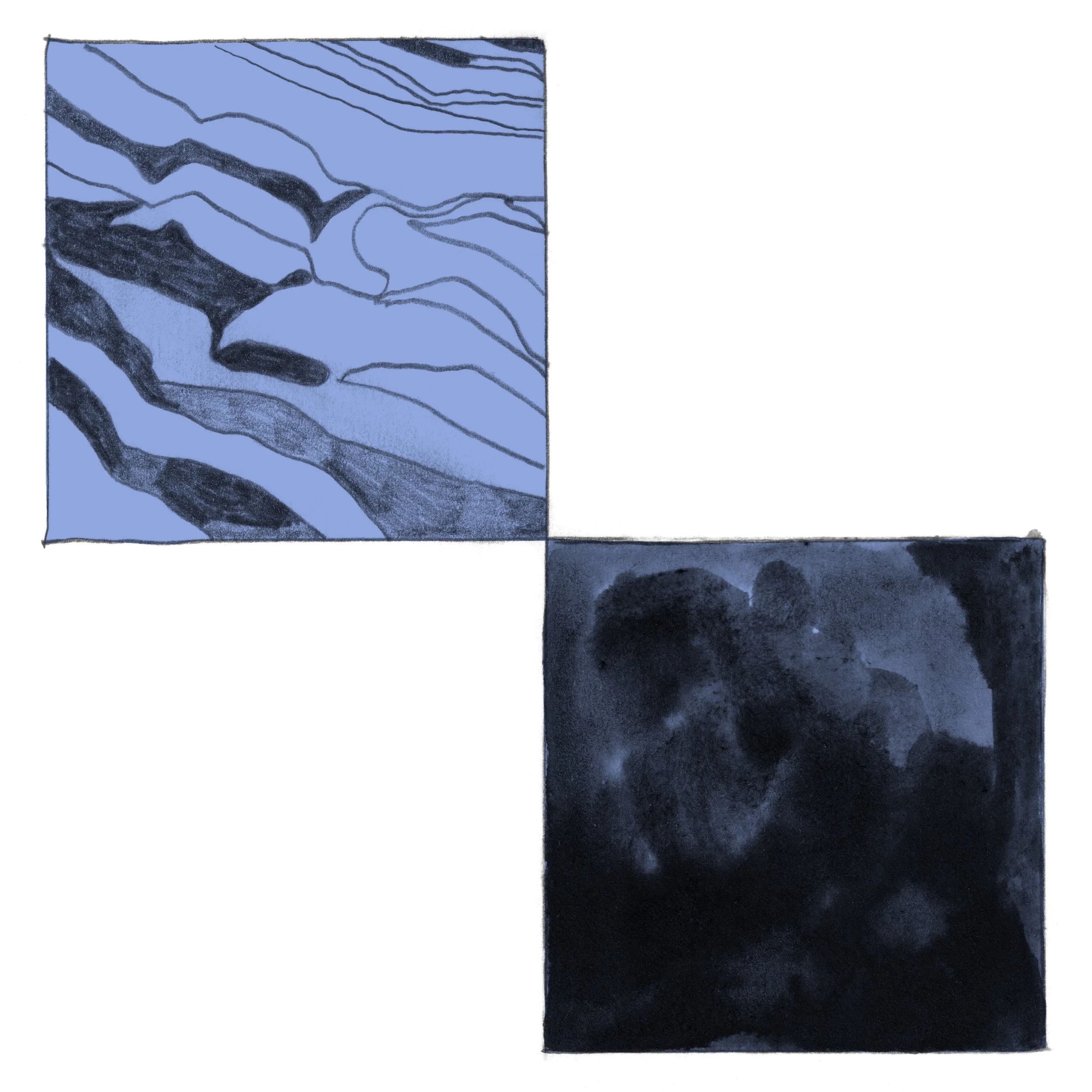
First of all, how dare you roll your eyes at me. Secondly, no, I’m saying it’s about the notes removed and the eerie, empty echo of their residue. And the friction they cause when plucked out plopped down elsewhere. And it’s about the nesting of contexts, too, frames within frames. Because this music is a heavily reworked album of tracks based on an already pre-existing song cycle adaptation of a graphic novel of the same name by the visual artist Aidan Koch, an existential meditation on marginalia and blinking out of existence that pretty tidily employs similar methods of erasure, mournful gray figures in washy watercolor (and in a beautiful twist of the Möbius Strip, Koch also created the album art).
Here is where I tell you some pertinent facts about how this album was made and by who. Over a number of sessions at Figure 8, a very well regarded Brooklyn recording studio, presided over by engineer Michael Hammond and guided spiritually by composer-of-note William Brittelle. An array of killer musicians on reeds, keys, saxophones, and gorgeous vocals, plus a remarkable appearance by chameleonic Shahzad Ismaily, his electric bass snarling. Featured throughout among some very beautiful vocal performances are melismas and growls from Peni Candra Rini, a striking inclusion. And at the shadowy center we find composer Dan Langa, setting intentions, engraving very minimal scores, setting Aidan Koch’s text to melody, digging the channel of sand through which the ocean of music flows, then disappearing into an Ableton mist with mountains of source material. How would you define his role? Conductor, selector, auteur, architect, all would be somewhat correct, yet even Langa knows not fully what he does in post-pro, thus the ensemble’s name - it often feels like Something Else is tweaking the tape.
This knotty, infinitely inward, Mandelbrot approach has few readily recognizable analogs, but here are a few orienting references: some of Bjork’s more outre, shapeshifting work (and maybe also her alignment with the electronic duo Matmos). Arthur Russell’s “Tower of Meaning,” his less-well-known collaboration with Robert Wilson, the Dirty Projector’s orchestral maneuvers (and tellingly band member Maia Friedman appears here as vocalist). Jim O’Rourke’s modular dissociations in Gastr del Sol or the radio transmission accretion of “My Life in the Bush of Ghosts.” And there is much to be recognized from well-regarded bravura and catholic appetites of the New Amsterdam Records catalog, founded by collaborator Brittelle.
Perhaps the most disorienting starfish in this particular tide pool is Langa’s inclusion of what seems to be typical studio chatter, tape left rolling - asking for more in the headphones, vocalists trying to find their starting note. Did they know they were being captured at this moment? Do they submit? If this marginalia is part of the music then - spiraling - truly isn’t everything we do always some kind of performance? (the horror: it is) And in this sonic world where nothing is necessarily representational - I dare you to accurately name every sound source on this album - it’s just as easy to imagine these snippets of studio documentary being staged. What is by design and what is by providence? Where is the edge of this thing? Relax, consider for a moment the inscription found on the backing board of Rauschenberg’s “Erased De Kooning” -
FRAME IS PART OF DRAWING -
The composer Dan Langa took home the recordings of his new project eager to splice takes, cut in surreptitious B-roll, and render the performances into something strange and new. This was the work - a graphic novel as inspiration, a killer’s row of studio pros, and a plan to aggressively stir the cauldron, something like contemporary chamber dub. But in reviewing the tape, he came across a voice he couldn’t place. Unintelligible yet distinct, caught at a distance in what seemed to be a room mic, an utterance he couldn’t recognize, otherworldly. That’s odd, he thought. But then, from another day entirely, the same five syllable sound, manifesting this time in the left channel of the piano. And when the same nearly human sound again appeared among peals of woodwinds, he dove deep into the DAW to find it.
Anomalous sounds, sure, okay, nothing unusual for Langa - he’s a working composer and a deep student of contemporary avant garde music, weird noises abound, having studied at Amherst and NYU with greats like Robert Honstein, Eric Wubbels, and Bang on a Can repetition gurus Julia Wolf & Michael Gordon. He’s taken cues from all the great, ghostly spectres of the 20th century, too, like John Cage’s otherworldly tape splicing or John Luther Adam’s uncanny ability to capture Earth spirit lamentations. And Langa is also interested in blurring distinctions and broadening our sometimes narrow ideas about how to imagine music - he’s notably one of the four composers behind CMNTX a by-artists-for-artists record label putting out really remarkably novel music. Through the effort, he’s both released and helped realize a smattering of fascinating, leftfield releases.
But here’s the thing about that eerie, unaccounted-for sound in these sessions: when Langa zoomed in on the track, the computer readout showed nothing out of the ordinary. And when he tried to play the sound back, it could not be replicated. It had disappeared. Was his computer glitching? Was he hallucinating? Was there something living in the walls? He ventured deeper, digital bit by bit, turning .WAVs inside out, slowing down, stretching out, and deleting, a process that rendered the remaining music nearly unrecognizable, more mangled and manipulated than he could have ever planned. Whatever spirit he sought had flown. And the process of hunting for it? Now also a mystery. He ran an audio gauntlet in search and could not retrace his steps. Up until that moment, the project lacked a name, so why not describe that to which he had succumbed? Fugue State, a method, a christening.
The project isn’t necessarily credited to Langa alone, nor is the project a traditional ensemble exactly, though he works with an impressive collection of New York City musicians, including the proliferous Shahzad Ismaily, noted vocalist in the gamelan tradition Peni Candra Rini, and New Music figure William Brittelle, whose work with Roomful of Teeth and with the New Amsterdam label make places him in a particular current-decade pantheon. Fugue State as an entity has more to do with the process, a tearing-apart-the-house, if you will. An aural Gordon Matta-Clark. The project’s first release is a spectral song cycle that lives in the Venn Diagram overlap of saxophone ambient, crumbling art song, and elegantly fried motherboard remixes. Named “After Nothing Comes” for the Aidan Koch graphic novel that is its original source material, the album will see release on Switch Hit Records - another artist collective - Spring 2026. The haunting, then the hunting, after nothing comes.
-
Released on Switch Hit Records
Music and lyrics based on the book by Aidan Koch
Music composed by Dan Langa
Produced by William Brittelle and Dan Langa
Recorded at Figure 8 Studio (October 2023 – October 2024)
Engineered and Mixed by Michael Hammond
Additional Mixing Dan Langa
Mastering Taylor Deupree
Liner notes by Ben Seretan
Album Artwork and Cassette Design by Aidan Koch
Morgan Guerin: Tenor, Soprano Saxophone
Timo Vollbrecht: Tenor, Alto Saxophone
Erika Dohi: Keyboards, Synths
Elias Stemeseder: Keyboards, Synths
Dan Langa: Keyboards, Synths, Theremin
William Brittelle: Synths
Shahzad Ismaily: Bass, Synths
Lauren Cauley: Violin
Melissa Achten: Harp
Andrea Scala: Drums
Maia Friedman: Vocals
Ethan Woods: Vocals, Guitar
Peni Candra Rini: Vocals
Videos
Dark (Official Visualizer)
video by Ian Crane
So What Is There (Official Video)
video by John Kim
Merch
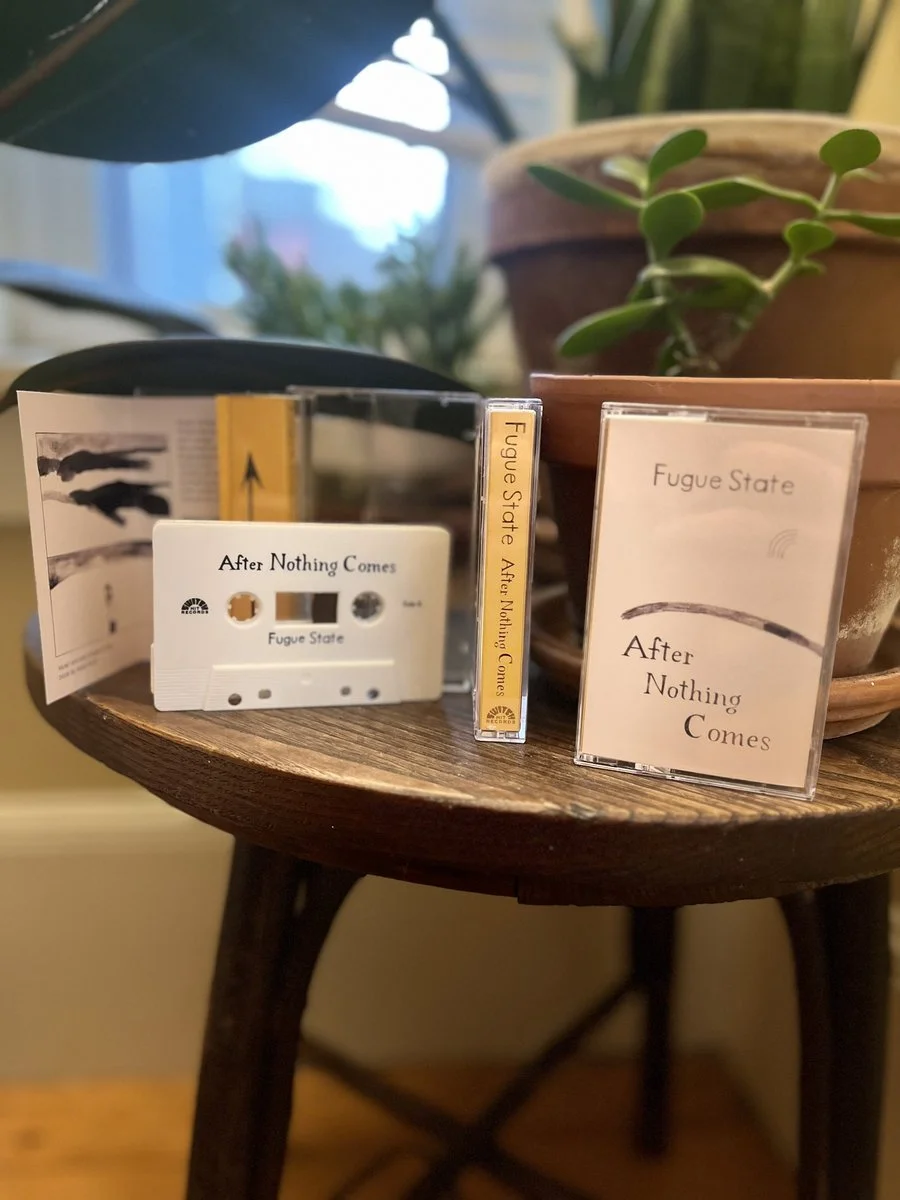
Cassette and J-Card Design by Aidan Koch. Limited run of 100 copies